Why Is My Golf Cart Not Starting? Club Car & EZGO Fixes
When your golf cart won’t start, check batteries first—they cause about 90% of no-start problems. A clicking sound usually means low battery voltage or a bad solenoid. Complete silence? That points to a key switch issue or blown fuse. Most Club Car and EZGO starting problems stem from dead batteries, corroded terminals, or faulty solenoids, and you can diagnose these yourself in under 30 minutes with basic tools.
Quick Diagnosis Checklist
Work through these common causes in order—they’re ranked by likelihood based on thousands of service calls:
- Dead or weak batteries – Test voltage (should read 12.6V+ per battery or 50.4V+ for 48V system)
- Corroded battery terminals – Look for white, green, or blue crusty buildup
- Faulty solenoid – Listen for a clicking sound when you turn the key
- Bad key switch or micro-switch – No sound at all when key is turned
- Tripped reset button or blown fuse – Check under the seat or near motor
- Loose or damaged battery cables – Wiggle test all connections
- Failed forward/reverse switch – Cart won’t start in either direction
- Controller or motor issues – Rare, but possible if all else checks out
Are Your Golf Cart Batteries Dead or Weak?
This is the number one reason golf carts won’t start. Even if you charged recently, individual cells can fail suddenly—especially in batteries over 4-5 years old.
Symptoms
- No sound when you turn the key, or very faint clicking
- Lights are dim or won’t turn on
- Cart worked yesterday but won’t start today
- Clicking gets faster or changes pitch when you press the pedal
How to Test
You’ll need a multimeter or voltmeter (available for under $20 at any hardware store):
- Test the full battery pack: Set your multimeter to DC voltage. Touch the red probe to the positive terminal of your first battery and the black probe to the negative terminal of your last battery. For a 48V system, you should read 50-52V when fully charged. Anything under 46V means your batteries need charging or replacement.
- Test each battery individually: A healthy 6V battery reads 6.3-6.4V, an 8V reads 8.4-8.5V, and a 12V reads 12.6-12.8V when fully charged. If one battery reads 0.5V or more lower than the others, it’s failed.
- Load test: Turn on your headlights and recheck voltage. If it drops more than 10%, your batteries can’t hold a charge under load.
How to Fix
If batteries are just low: Charge them fully using your onboard charger. This should take 6-10 hours from a deep discharge. Make sure your charger is plugged into a working outlet and the charge indicator light comes on.
If one or more batteries have failed: You need to replace them. Important: Always replace all batteries at once. Never mix old and new. A new battery in a pack of old ones will be drained rapidly by the weak cells.
For Club Car models (Precedent, DS, Onward), check our Club Car electrical parts section for compatible battery options. EZGO owners can find the right fit in our EZGO parts catalog.
Difficulty: Easy to test, moderate to replace batteries
Time Required: 10 minutes to test, 45-60 minutes to replace batteries
Tools Needed: Multimeter, 10mm and 1/2″ wrenches, safety glasses, gloves
⚠️ SAFETY WARNING: Golf cart batteries contain sulfuric acid and produce explosive hydrogen gas during charging. Always wear safety glasses and gloves. Remove all jewelry. Work in a ventilated area. Never smoke or create sparks near batteries. Disconnect the negative cable first, reconnect it last.
Do You Have Corroded Battery Terminals?
Corrosion creates resistance that prevents current from flowing, even if your batteries are fully charged. This is especially common in humid climates or if you’ve had battery acid spills.
Symptoms
- White, green, blue, or crusty buildup on battery posts or cable ends
- Intermittent starting—works sometimes but not others
- Cart starts after you wiggle battery cables
- Batteries test good but cart still won’t start
How to Test
Visual inspection is usually enough. Open your battery compartment (under the seat on most models) and look at each connection point. Even a small amount of corrosion can cause problems. Check that cables are tight, too—you shouldn’t be able to twist a terminal by hand.
How to Fix
- Disconnect the batteries: Always remove the negative (black) cable first from the battery pack.
- Clean the terminals: Mix 2 tablespoons of baking soda with 1 cup of water. Pour over corroded areas—it will foam up, neutralizing the acid. Scrub with a wire brush until you see shiny metal.
- Clean cable ends: Use the wire brush on the inside of cable clamps and both sides of metal connectors.
- Rinse and dry: Spray with water, then dry thoroughly with a rag.
- Apply protectant: Spray terminals with battery terminal protectant or apply a thin layer of petroleum jelly to prevent future corrosion.
- Reconnect: Attach positive (red) cables first, then negative (black). Tighten until snug but don’t over-torque.
If your cables are badly corroded or damaged, you’ll need replacements. Browse our wholesale golf cart parts for battery cables and terminal kits.
Difficulty: Easy
Time Required: 15-20 minutes
Tools Needed: Wire brush, baking soda, water, wrenches, rags, safety glasses
Is Your Solenoid Clicking But Cart Won’t Start?
The solenoid is a heavy-duty relay that sends power from your batteries to the motor. When it fails, you’ll usually hear a click but nothing else happens. This is one of the most common Club Car and EZGO starting problems.
Symptoms
- Loud click or series of clicks when you turn the key
- Click but no motor sound or movement
- Solenoid feels hot after trying to start
- Burnt smell near the solenoid
How to Test
First, locate your solenoid. On most Club Car DS and Precedent models, it’s under the seat near the batteries. On EZGO TXT and RXV models, check under the seat or near the motor.
- Listen test: Turn the key and listen. A single loud click means the solenoid is activating but not completing the circuit. Rapid clicking means low voltage is reaching the solenoid (go back and check batteries).
- Bypass test: This confirms a bad solenoid. With the key OFF, use an insulated screwdriver to briefly touch the two large terminals on the solenoid simultaneously. If the cart lurches forward, the solenoid is bad. WARNING: Make sure the cart is in neutral or blocked, and stand to the side—the cart WILL move if the solenoid is the problem.
- Voltage test: With the key ON, check voltage at the small terminals on the solenoid. You should read 12V or more. If you do, but there’s no voltage at the large terminals, the solenoid is faulty.
How to Fix
Solenoids can’t be repaired—you need to replace them. Good news is they’re relatively inexpensive ($30-60) and easy to swap:
- Disconnect the negative battery cable
- Take a photo of the wire connections on your solenoid
- Label each wire with tape before disconnecting
- Unbolt the old solenoid (usually two 10mm bolts)
- Install the new solenoid in the same orientation
- Reconnect wires according to your photo
- Reconnect battery and test
Club Car vs EZGO Note: Club Car models typically use a 36V or 48V solenoid depending on your system voltage. EZGO carts use brand-specific solenoids—don’t mix them. Check our Club Car electrical parts or EZGO parts sections for the exact match for your model year.
Difficulty: Easy to moderate
Time Required: 20-30 minutes
Tools Needed: 10mm socket/wrench, camera phone, masking tape, marker
Could Your Key Switch or Micro-Switch Be Faulty?
If you turn the key and hear absolutely nothing—no click, no sound at all—the problem is usually before the solenoid in the electrical chain. The key switch or the micro-switch (attached to the pedal or F/R lever) might have failed.
Symptoms
- Complete silence when turning the key
- No dashboard lights or gauges
- Cart was working, you parked it, and now nothing
- Key feels loose or turns too easily
How to Test
Key switch test:
- Turn the key to ON and check if your headlights work. If nothing electrical works, the key switch is probably bad.
- Use a multimeter to check for 12V coming OUT of the key switch when it’s in the ON position. No voltage means a failed switch.
Micro-switch test (for carts with pedal safety switches):
- Locate the micro-switch—usually under the pedal or attached to the F/R selector.
- With the key ON, press the pedal fully and listen for a click from the solenoid. No click might mean the micro-switch isn’t closing the circuit.
- Bypass the micro-switch temporarily by connecting its two wires together (use a jumper wire). If the cart starts, the micro-switch is bad.
How to Fix
For key switch replacement:
- Disconnect batteries
- Remove the dash panel to access the back of the key switch
- Photograph wire connections
- Disconnect wires and remove the old switch
- Install new switch and reconnect wires to match your photo
- Test before reassembling the dash
For micro-switch replacement:
- Locate and photograph the switch and its wiring
- Disconnect wires (usually push-on connectors)
- Unbolt or unclip the old switch
- Install new switch in the same position
- Reconnect wires and test pedal operation
Both Club Car and EZGO use different key switch designs depending on model year. Check our Club Car electrical parts section for Precedent and DS models, or our EZGO catalog for TXT and RXV switches.
Difficulty: Moderate
Time Required: 30-45 minutes
Tools Needed: Screwdrivers, socket set, multimeter, camera phone
Have You Checked the Reset Button or Fuses?
Many golf cart owners don’t know their cart has a reset button (also called an inertia switch). This safety feature cuts power after a hard impact or rollover. Blown fuses can also cause a no-start condition.
Symptoms
- Cart won’t start after hitting a bump or pothole
- Everything was fine, then suddenly nothing works
- Some electrical components work, others don’t
How to Test and Fix
Reset button location by brand:
- Club Car DS (gas): Near the carburetor or on the frame under the seat
- Club Car Precedent: Under the dash near the controller
- EZGO TXT: On the motor or near the controller under the seat
- EZGO RXV: Under the dash or near the motor
The reset button is usually red and may have popped out. Simply push it back in until you hear/feel a click.
Fuse locations:
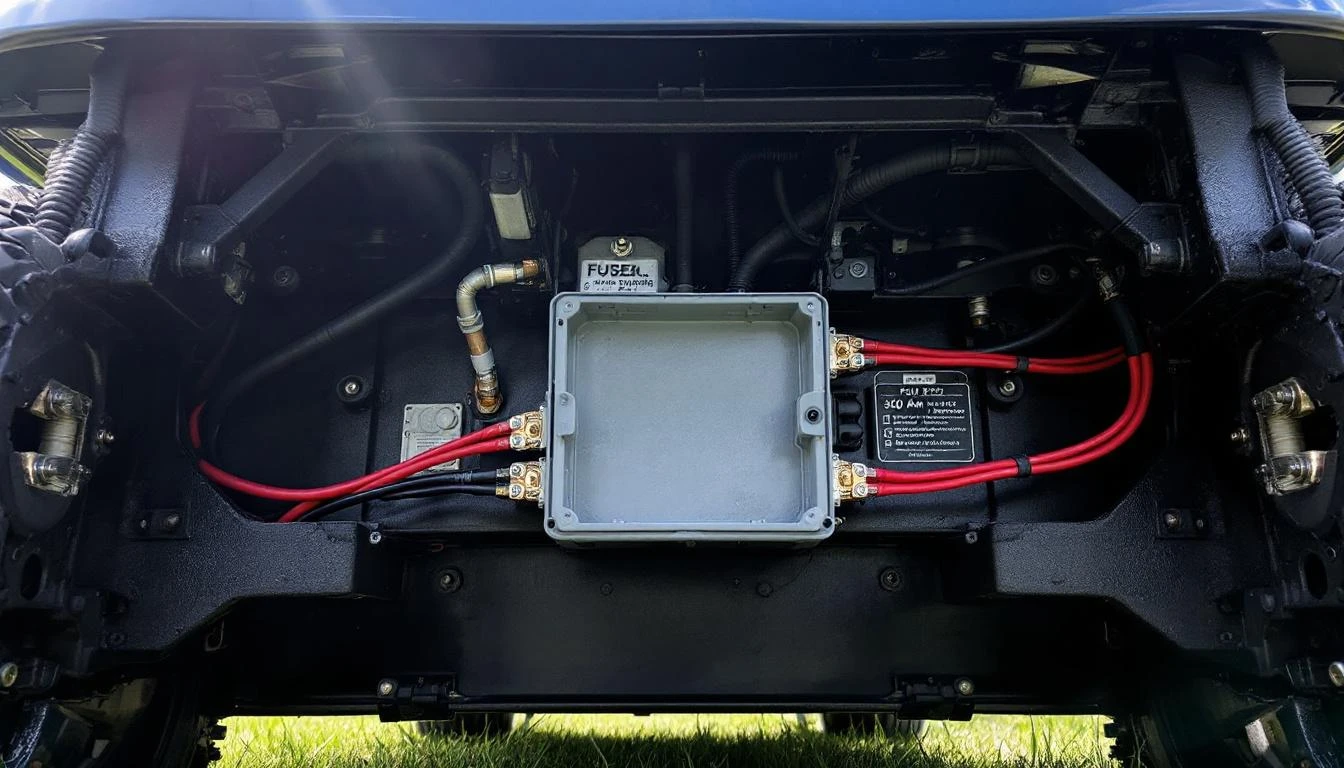
- Most electric carts have a main fuse near the battery pack (usually 250-400 amp)
- Accessory fuses are often in a fuse block under the dash
- Gas carts have smaller blade fuses for ignition and accessories
To test a fuse, remove it and look for a broken wire inside the clear plastic, or use a multimeter to check continuity. Replace any blown fuses with the exact same amperage rating.
Difficulty: Very easy
Time Required: 5-10 minutes
Tools Needed: Flashlight, replacement fuses if needed
Are Your Battery Cables Loose or Damaged?
Vibration from normal use can loosen battery cable connections over time. Damaged cables can prevent current flow even if everything else is perfect.
Symptoms
- Intermittent starting—sometimes works, sometimes doesn’t
- Cart starts after you wiggle wires or bump the seat
- Visible fraying, cracks, or melted insulation on cables
- Burnt smell near battery connections
How to Test
- Perform the wiggle test—try to rotate each battery terminal connection by hand. They should be solidly tight.
- Inspect all cables visually for damage, especially where they bend or connect to terminals
- Check for heat damage—cables that get hot indicate resistance from poor connections
- Look for green or white corrosion inside cable ends (not just on terminals)
How to Fix
For loose connections: Simply tighten with the appropriate wrench until snug. Don’t over-tighten—you can crack battery posts.
For damaged cables: Replace them. Never tape or try to repair a damaged battery cable—they carry 200+ amps and must be in perfect condition.
When replacing cables, measure the length of your old cables and note the terminal types (ring, lug, etc.). Our wholesale parts section carries pre-made battery cables in standard lengths, or you can purchase bulk cable and terminals to make custom lengths.
Difficulty: Easy to tighten, moderate to replace
Time Required: 10 minutes to tighten, 30-45 minutes to replace
Tools Needed: Wrenches, wire cutters, crimping tool (for cable replacement)
Could Your Forward/Reverse Switch Be the Problem?
The F/R switch (or shifter) tells your cart which direction to go. If it fails or gets stuck between positions, the safety system prevents starting. This is more common on older carts or those exposed to weather.
Symptoms
- Cart won’t start in forward OR reverse
- Switch feels loose, sticky, or doesn’t click into position
- Cart starts in one direction but not the other
- Switch lever moves but nothing happens
How to Test
- Rock the F/R switch back and forth firmly through all positions several times
- Try starting in both forward and reverse—if it works in one direction, the switch is probably bad
- Check underneath the switch for loose or disconnected wires
- With a multimeter, test for continuity through the switch in both positions
How to Fix
If it’s just dirty or sticky: Spray electrical contact cleaner into the switch mechanism and work it back and forth 20-30 times. Let it dry and test.
If the switch is faulty: Replace it. F/R switches differ significantly between brands:
- Club Car DS: Uses a lever-style switch mounted on the dashboard
- Club Car Precedent: Uses a rocker switch or lever depending on year
- EZGO TXT: Lever-style switch on the dash
- EZGO RXV: Electronic switch integrated with the dash
Replacement involves removing the dash access panel, photographing connections, disconnecting wires, unbolting the old switch, and reversing the process with the new one. Find the right switch for your model in our Club Car electrical components or EZGO parts sections.
Difficulty: Moderate
Time Required: 30-40 minutes
Tools Needed: Screwdrivers, socket set, electrical contact cleaner, camera phone
When to Call a Professional
Most golf cart starting problems are DIY-friendly, but some situations call for professional help:
- You’re not comfortable working with electrical systems: Golf cart batteries carry enough current to cause serious injury. There’s no shame in calling a pro if you’re uncertain.
- You’ve checked everything above and the cart still won’t start: The problem might be in the controller, motor, or wiring harness—these require specialized diagnostic tools.
- You see smoke, smell burning electronics, or find melted wires: Stop immediately. These indicate a serious electrical fault that could cause a fire.
- The cart has been modified or has aftermarket parts: Non-standard wiring can be dangerous to troubleshoot without documentation.
- Your cart is still under warranty: DIY repairs might void coverage—check your warranty terms first.
A qualified golf cart technician has diagnostic computers that can read error codes from your controller, pinpoint wiring faults, and load-test components properly. The typical diagnostic fee ($75-150) is money well spent if it prevents buying parts you don’t need or making the problem worse.
Prevention Tips to Avoid Starting Problems
Most no-start situations are preventable with basic maintenance. Here’s how to keep your Club Car or EZGO starting reliably:
Monthly Maintenance
- Check battery water levels (for flooded lead-acid batteries)—add distilled water if plates are exposed
- Clean battery terminals with a wire brush and check for tightness
- Inspect cables for fraying, cracks, or damage
- Test battery voltage even if the cart is working—catch weak batteries early
Quarterly Maintenance
- Full battery capacity test using a hydrometer or load tester
- Check all electrical connections for corrosion or looseness
- Clean battery tops to prevent current leakage through dirt/acid buildup
- Inspect the solenoid for signs of overheating or pitting on contacts
Storage Best Practices
- Charge batteries fully before storing for more than a week
- Disconnect the negative battery cable for storage over 30 days
- Keep batteries on a maintenance charger if storing for extended periods
- Store in a cool, dry location—extreme temperatures kill batteries
Usage Habits
- Charge after every use rather than waiting for batteries to fully discharge
- Don’t store with partial charge—sulfation damages battery plates
- Avoid deep discharges when possible—they dramatically shorten battery life
- Use your cart regularly—sitting unused is harder on batteries than normal use
Stock critical spares from our wholesale parts inventory—having a spare solenoid, key switch, or set of fuses on hand means you’re back on the course in minutes instead of waiting days for shipping.
Frequently Asked Questions
Why does my Club Car click but not start?
A clicking sound from your Club Car typically means the solenoid is activating but can’t complete the circuit. The most common causes are weak batteries (under 48V for a 48V system), a faulty solenoid with burned contacts, or poor connections on the solenoid terminals. Check battery voltage first, then clean and tighten all solenoid connections. If the solenoid is hot to the touch after clicking, it needs replacement.
How do I know if my EZGO golf cart batteries are dead?
Test each battery individually with a multimeter. A healthy 12V battery should read 12.6-12.8V when fully charged, a 6V should read 6.3-6.4V, and an 8V should read 8.4-8.5V. If any battery reads more than 0.5V lower than the others, it’s failed. Also perform a load test—turn on headlights and recheck voltage. A drop of more than 10% indicates batteries that can’t hold charge under load. Most EZGO batteries last 4-6 years with proper maintenance.
What causes a golf cart to suddenly stop working?
Sudden failure (cart was working, now it’s not) is usually caused by a blown fuse, tripped reset button, sudden battery cell failure, or a broken wire/connection. Start by checking for a tripped reset button under the seat or near the controller—this is often overlooked. Then check the main fuse near the battery pack. If both are okay, test battery voltage and inspect all visible wire connections for breaks or disconnections.
Can I jump-start my golf cart like a car?
No, never jump-start a golf cart with a car battery or car jump starter. Golf carts use a series of batteries (36V or 48V systems) while cars use 12V. Connecting a 12V source can damage your controller, solenoid, and other components. If your golf cart batteries are dead, you need to charge them properly with your onboard charger or replace them. There’s no safe shortcut.
Why won’t my golf cart start after sitting all winter?
Batteries self-discharge during storage, and if they drop too low, they can sulfate and become permanently damaged. After winter storage, first check battery voltage—if it’s below 36V (for a 48V system), the batteries may be too depleted to accept a charge. Try charging for 24 hours. If voltage doesn’t rise, the batteries have frozen or sulfated beyond recovery and need replacement. This is why it’s critical to store carts fully charged and on a maintenance charger.
How much does it cost to fix a golf cart that won’t start?
Costs vary widely depending on the issue. A DIY fix for corroded terminals costs about $5 for cleaning supplies. A solenoid replacement costs $30-60 for the part plus 20 minutes of your time. New batteries are the most expensive repair at $600-1,200 for a complete set (installed). Key switches run $25-50, and fuses cost under $10. Professional diagnosis typically costs $75-150, with labor adding $60-90 per hour for repairs you can’t do yourself.
What’s the difference between a Club Car and EZGO solenoid?
While they perform the same function, Club Car and EZGO solenoids have different mounting configurations, terminal layouts, and voltage specifications. Club Car typically uses continuous-duty solenoids, while EZGO models may use intermittent-duty versions depending on the model year. The brands are not interchangeable—always purchase the solenoid designed for your specific cart brand and voltage system (36V vs 48V). Using the wrong solenoid can cause starting problems or electrical damage.
Should I replace one dead battery or all of them?
Always replace all batteries as a set, never just one. Golf cart batteries work as a team in series—one weak battery will drag down the entire pack and cause the new battery to fail prematurely as it tries to compensate. Mixing old and new batteries also causes uneven charging, which damages both. While replacing all batteries is more expensive upfront, it’s far more economical than replacing batteries one at a time every few months.